
Database Sharding & Partitioning: Scaling Beyond a Single Database
Database Sharding & Partitioning: Scaling Beyond a Single Database
"A single database server is a single point of failure, a single point of congestion, and a single point of embarrassment when it dies under load."
Introduction
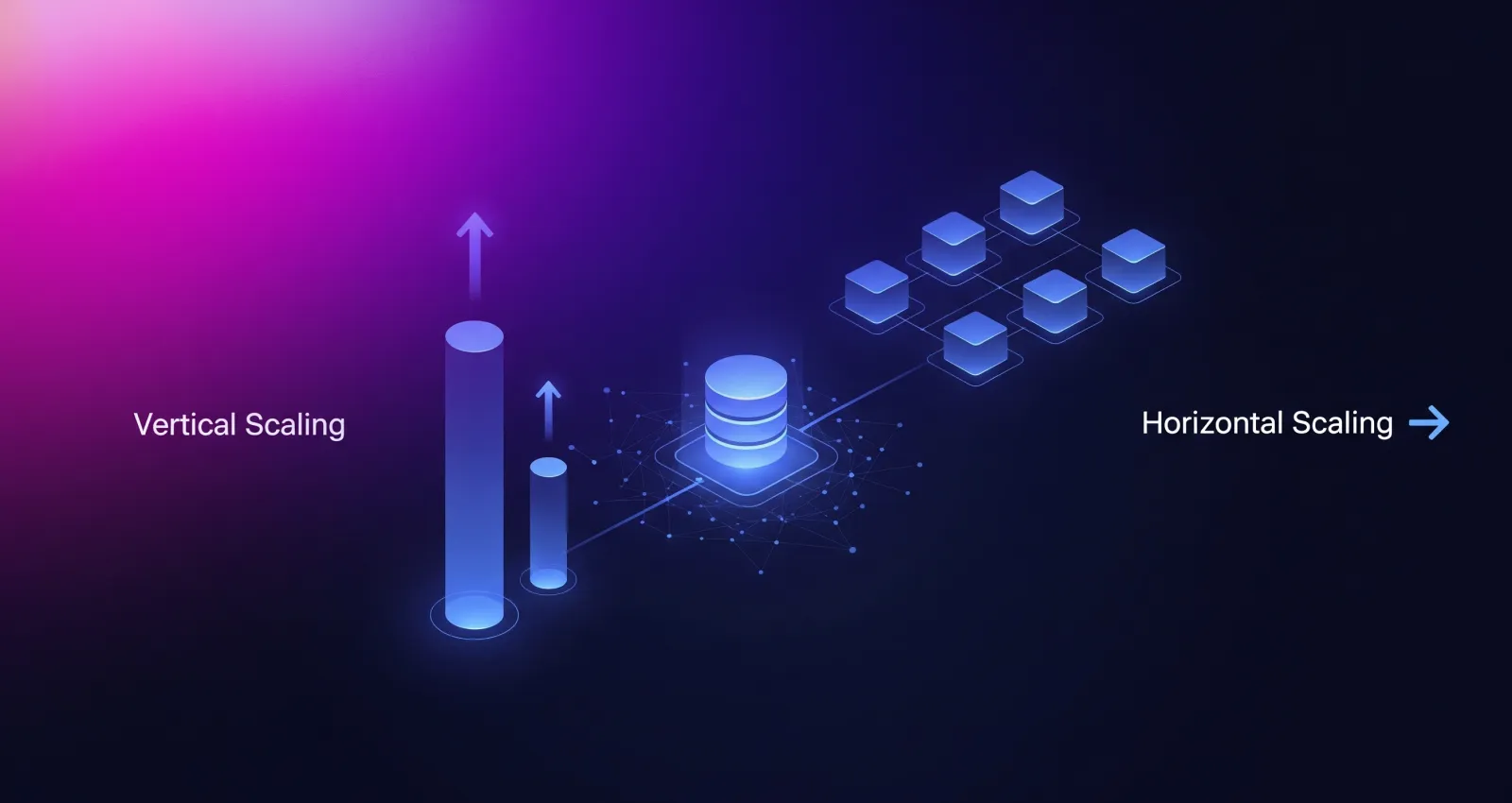
At some point, every backend system faces it: queries slow down, disk fills up, CPU maxes out, and your single Postgres instance is begging for mercy. Vertical scaling (bigger machine) buys time — but not forever.
The permanent solution is horizontal scaling of your database layer: splitting data across multiple nodes using partitioning and sharding.
In 2026, with data volumes exploding and latency expectations shrinking, every backend engineer needs to understand these patterns deeply — not just in theory, but in practice.
Partitioning vs Sharding: The Core Distinction
These terms are often confused. Here's the clear separation:
| Concept | Definition |
|---|---|
| Partitioning | Splitting a table into smaller pieces on the same database server |
| Sharding | Splitting data across multiple separate database servers |
Think of partitioning as organizing files into folders on one hard drive. Sharding is distributing those folders across many hard drives.
Partitioning: Divide Within a Single Server
Range Partitioning
Split data based on a contiguous range of values — commonly used with dates.
1-- PostgreSQL: Partition orders by year
2CREATE TABLE orders (
3    order_id BIGSERIAL,
4    user_id  BIGINT NOT NULL,
5    total    DECIMAL(10,2),
6    created_at TIMESTAMPTZ NOT NULL
7) PARTITION BY RANGE (created_at);
8
9CREATE TABLE orders_2024 PARTITION OF orders
10    FOR VALUES FROM ('2024-01-01') TO ('2025-01-01');
11
12CREATE TABLE orders_2025 PARTITION OF orders
13    FOR VALUES FROM ('2025-01-01') TO ('2026-01-01');
14
15CREATE TABLE orders_2026 PARTITION OF orders
16    FOR VALUES FROM ('2026-01-01') TO ('2027-01-01');
Best for: Time-series data, logs, audit trails — where queries filter by date range.
Hash Partitioning
Data is distributed based on a hash of the partition key, providing even distribution.
1-- PostgreSQL: Hash-partition users into 4 buckets
2CREATE TABLE users (
3    user_id BIGSERIAL,
4    email   TEXT NOT NULL,
5    name    TEXT
6) PARTITION BY HASH (user_id);
7
8CREATE TABLE users_0 PARTITION OF users FOR VALUES WITH (MODULUS 4, REMAINDER 0);
9CREATE TABLE users_1 PARTITION OF users FOR VALUES WITH (MODULUS 4, REMAINDER 1);
10CREATE TABLE users_2 PARTITION OF users FOR VALUES WITH (MODULUS 4, REMAINDER 2);
11CREATE TABLE users_3 PARTITION OF users FOR VALUES WITH (MODULUS 4, REMAINDER 3);
Best for: Uniform distribution of write load across partitions.
List Partitioning
Partition based on explicit values — perfect for categorical data like region or status.
1-- Partition by region
2CREATE TABLE transactions (
3    txn_id  BIGSERIAL,
4    region  TEXT NOT NULL,
5    amount  DECIMAL(12,2)
6) PARTITION BY LIST (region);
7
8CREATE TABLE transactions_india  PARTITION OF transactions FOR VALUES IN ('IN');
9CREATE TABLE transactions_us     PARTITION OF transactions FOR VALUES IN ('US');
10CREATE TABLE transactions_eu     PARTITION OF transactions FOR VALUES IN ('EU');
Best for: Multi-tenant apps, geo-based data isolation.
Sharding: Distribute Across Multiple Servers
Sharding scales beyond a single machine by distributing data across shard nodes. Each shard is an independent database — own storage, own compute.
1                        ┌─────────────┐
2Client ──► API Layer ──►│ Shard Router│
3                        └──────┬──────┘
4              ┌────────────────┼────────────────┐
5              ▼                ▼                ▼
6         ┌─────────┐     ┌─────────┐     ┌─────────┐
7         │ Shard 0 │     │ Shard 1 │     │ Shard 2 │
8         │users 0-3M│    │users 3-6M│    │users 6-9M│
9         └─────────┘     └─────────┘     └─────────┘
Sharding Strategies
1. Range-Based Sharding
Assign data to shards based on ranges of the shard key.
// Java: Determine shard from userId range
public String getShardForUser(long userId) {
    if (userId < 3_000_000) return "shard-0";
    if (userId < 6_000_000) return "shard-1";
    return "shard-2";
}
Risk: Hot shards if data is unevenly distributed (new users always land on the latest shard).
2. Hash-Based Sharding
Apply a consistent hash to the shard key to distribute load evenly.
// Java: Hash-based shard routing
public DataSource getShardDataSource(long userId) {
    int shardIndex = (int) (userId % shards.size());
    return shards.get(shardIndex);
}
Risk: Re-sharding is painful — adding a shard requires remapping large portions of data.
3. Consistent Hashing
Solves the re-sharding problem by placing both data and nodes on a hash ring. Adding or removing a node only affects adjacent keys.
1// Consistent hashing ring lookup (simplified)
2public String resolveShardNode(String key) {
3    long hash = hashFunction(key);
4    // Navigate ring clockwise to find the nearest node
5    SortedMap<Long, String> tail = ring.tailMap(hash);
6    if (tail.isEmpty()) {
7        return ring.firstValue(); // wrap around
8    }
9    return tail.get(tail.firstKey());
10}
Used by: DynamoDB, Cassandra, Redis Cluster.
Choosing the Right Shard Key
The shard key is the most critical decision. A bad choice creates hot spots — one shard handling 90% of traffic while others sit idle.
| Shard Key Type | Pros | Cons |
|---|---|---|
| User ID | Uniform distribution for user data | Cross-user queries span multiple shards |
| Tenant ID | Clean tenant isolation | Unequal tenant sizes cause imbalance |
| Geography | Data locality, compliance | Uneven regional growth |
| Timestamp | Natural for time-series | All writes land on latest shard (hot!) |
Golden Rule: Choose a shard key with high cardinality and even write distribution. Avoid monotonically increasing keys (like auto-increment IDs) as the sole shard key — they create write hot spots.
The Hard Problems With Sharding
Cross-Shard Queries
Queries that need data from multiple shards require scatter-gather — fan out the query to all shards, aggregate results. Expensive.
1// Scatter-gather across all shards
2public List<Order> getOrdersForPeriod(LocalDate from, LocalDate to) {
3    return shards.parallelStream()
4        .flatMap(shard -> shard.query(
5            "SELECT * FROM orders WHERE created_at BETWEEN ? AND ?", from, to
6        ).stream())
7        .sorted(Comparator.comparing(Order::getCreatedAt).reversed())
8        .collect(Collectors.toList());
9}
Mitigation: Design queries so 90% of them hit a single shard. Denormalize data where needed.
Distributed Transactions
ACID transactions don't span shard boundaries without coordination protocols like 2-Phase Commit (2PC) or the Saga pattern.
// Saga: Order spans user-shard + inventory-shard + payment-shard
// Step 1: Reserve inventory (Shard-Inventory)
// Step 2: Charge payment  (Shard-Payment)
// Step 3: Confirm order   (Shard-Orders)
// If Step 2 fails → compensate: release inventory reservation
Advice: Design your domain so critical transactions stay within a single shard. Use eventual consistency for cross-shard operations.
Rebalancing (Re-sharding)
As data grows, you'll need to split shards. This is operationally complex:
- Choose a split point
- Migrate half the data to a new shard
- Update the routing table
- Do it without downtime
Tools like Vitess (YouTube's database proxy for MySQL) and Citus (Postgres extension) automate much of this.
Practical Tooling in 2026
| Tool | Database | What It Does |
|---|---|---|
| Vitess | MySQL | Transparent sharding, connection pooling, online schema changes |
| Citus | PostgreSQL | Distributed tables, colocation, shard rebalancing |
| PlanetScale | MySQL (Vitess-based) | Managed horizontal scaling, branching |
| CockroachDB | PostgreSQL-compatible | Built-in sharding + distributed transactions |
| Cassandra | Wide-column | Automatic partitioning with consistent hashing |
| MongoDB | Document | Built-in sharding via mongos router |
Real-World Reference: How Instagram Sharded PostgreSQL
When Instagram hit 100M users, they faced the classic sharding dilemma. Their approach:
- Logical shards in one Postgres instance — 512 logical shards per physical server
- Shard key:
user_idembedded in every entity ID (using a custom ID scheme) - Routing: Application-level shard map
- Migration: Used logical shards to make physical re-sharding easy — just move logical shards to new servers
The key insight: Plan for sharding before you need it by embedding the shard key into your ID format early.
Decision Framework
1Is your table < 50GB with predictable growth?
2    → Don't shard yet. Use table partitioning + read replicas.
3
4Is one Postgres instance insufficient?
5    → Consider Citus (Postgres) or Vitess (MySQL) first.
6
7Do you have multiple independent tenants?
8    → Shard by tenant_id for clean isolation.
9
10Do you have global users and need data locality?
11    → Shard by geography + use read replicas per region.
12
13Is your write throughput exceeding a single master?
14    → Horizontal sharding is the answer.
Conclusion
Sharding and partitioning are not premature optimizations — they're architectural decisions that become much harder to retrofit later. Understand the patterns early, design your shard keys intentionally, and choose tools that make rebalancing manageable.
The systems that scale painlessly to hundreds of millions of users are the ones that treated data distribution as a first-class architectural concern from the start.
"Your database doesn't need to be one database. It just needs to look like one to the rest of your system."
Build accordingly. 🔥
Written by
Kirtesh Admute
Full-stack engineer and digital architect — building scalable, production-grade systems with real-world impact.

&w=3840&q=75)